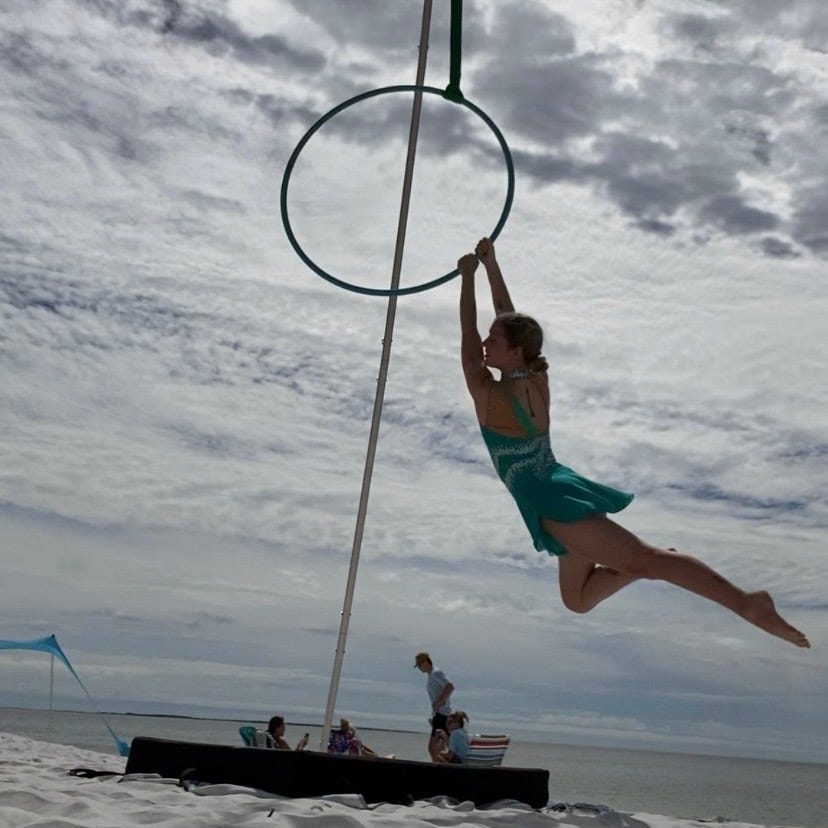
Introducing the Exercises: Inversions

Inversions. This word can be loaded with emotions for aerialists. Do inversions make you feel frustrated, fearful, hopeless, successful, motivated, weightless, or strong? Are you the rare bird who showed up to class the first day and floated upside down effortlessly, or have inverts been a challenging journey? Are you a teacher who wants to help every student achieve their best, no matter their background? Whether you are an absolute beginner or a long time aerialist, training inversions will be a staple of each session. The three main aspects of inverting to emphasize are the eccentric portion, multiple grips and leg positions, and dynamic considerations.
In the previous exercise, you checked in with the destination, inverted hanging. Now is the time to refine the journey there. However, perhaps more important is the return flight. Let’s talk about eccentric inversions, negatives. This is the back half of the exercise. This is when you are coming down. Not only is it safest to come down from an inversion slowly and with control, it is an opportunity to build so much strength. (This is also my favorite way to have people train for pull ups!) Beginner aerialists may start with support, such as a knot in the fabric, heavy spotting, or a spotting block. On the way down, form is most important— elbow in, shoulders away from ears, back neutral, controlled legs. The inversion is built here. For aerialists working on straight leg inversions, perhaps they can go upside down with bent legs then focus all their energy on straightening their legs completely on the way down. This is the same for those working on straight arms. Embrace the negatives.
Once a certain level of progression is mastered in one type of inversion, i.e. a student can independently perform a tuck inversion with a separated grip on a bar, it’s high time to generalize the skill. That student can invert independently with bent arms and bent legs, so they should not only practice it with knees together (tuck) but also knees apart (straddle). They should practice inverting with a separated grip, close grip, vertical grip, and horizontal grip. Variations can be as creative as you can imagine. Generalizing the inversion is excellent for the brain as well as expanding the toolbox of the aerialist. The more ways someone can invert at their level, the more freedom they have to learn knew skills and create interesting choreography.
When students can invert confidently at their level, adding a spin or a small swing can be a lot of fun and look so gorgeous. Not only that, it challenges the inversion with new forces. All of a sudden, there are a lot more physics at play. Now, I’m no scientist, but there are two main things that happen. The hips get pulled outward from center, and the legs have further to travel. Simply put, the shoulders have more work to do to keep the hips up, and the legs have to generate a bit of force in the direction of the spin to keep up with the torso. I like to have beginners start with a kick spin. On fabric, this can even be down in a knot. With weight centered under the rigging point, the student will bring the leading leg back into a small lunge. The leading leg quickly draws a circle back to front to wind up, then sharply upwards, followed by the second leg. This is the most elementary version of a flair. With the proper rigging and other safety measures, students can also practice inverting at the peak of a small swing. It’s a lot of fun, and it challenges the aerialist’s spatial awareness and control.
Training inversions can be more fun than drilling 3 standard straddle inversions each side every single class, though there is certainly a place for repetition. Through the smart use of eccentric/negative inversions, aerialists can level up. Additionally, there is so much groundwork that can support inversions, especially for those seeking to break through a plateau… but more on that later! Through experimenting with multiple grips and leg positions, aerialists will increase their breadth. Through beginning just a little bit of intentional spinning and swinging, aerialists will work through new challenges, experience new forces, and enter into the exciting world of dynamics! Strategic emphasis of these aspects can keep even the most seasoned aerialists engaged, and they can transform a frustrating battle with inversions into an exciting journey!
This is the third essay of the series: Introducing the Exercises
The first exercises or drills each class on an aerial apparatus should be comprehensive, consistent, and yet flexible enough to be made suitable and properly challenging for every level. The Aerial Method’s order of exercises builds upon itself and forms a living foundation that supports the breadth of aerial work. In this series, learn about each exercise and how to implement them.